Your position will refresh as you move. High-accuracy updates will drain your battery faster than usual.
Every place on Rarotonga has an address made up of a number and a letter of the Maori alphabet.
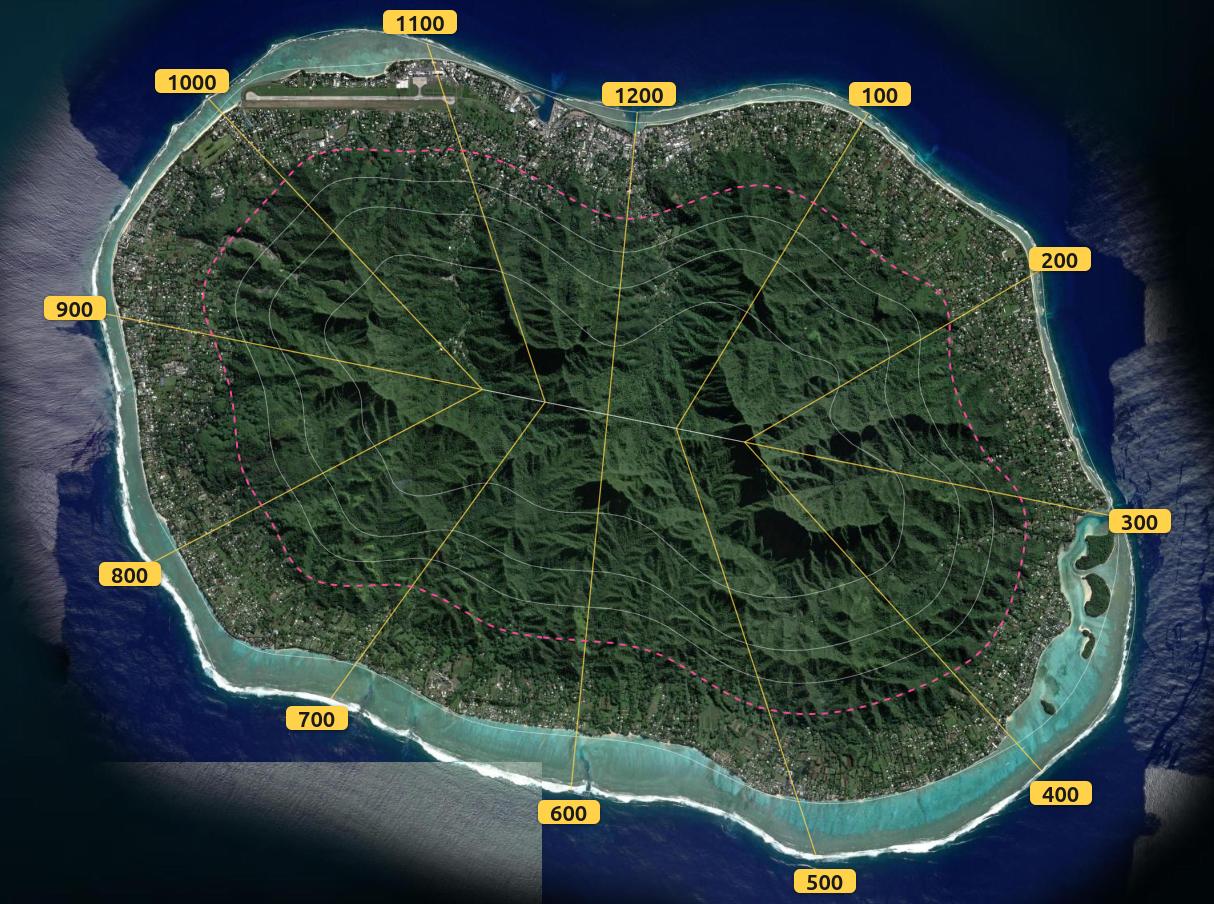
The numbers 1-1200 go clockwise around the island starting at Avarua harbour. There are also rings around the island, like an onion, which are named with the letters of the Maori alphabet, starting from the reef and going inland to the mountains. The intersection of these numbers and letters is the block address, like 934 Katai Blk
Why don't blocks line up with sections or roads?
The radial grid is structured; our roads and sections are unstructured, so it is difficult to align the two.
What is my address if a block is shared by two houses?
Use a sub-block letter to distinguish the houses. For example, instead of 34 Kotai Blk, the two houses can use 34f Kotai Blk and 34m Kotai Blk.
Rarotonga is sliced into sectors that radiate from the centre of the island out to the reef. Sectors are numbered 1 to 1200 going clockwise — like a clock.
Tip: Distance along the Ara Tapu main road between successive hours is roughly 2.7 km, or 37 sector per kilometer. So the difference between two sector numbers gives a quick distance estimate.
The island is also divided into rings, going out from the centre like an onion. Rings are named with the Cook Islands Maori alphabet: A, E, I, O, U, Nga, Nge, Ngi, Ngo, Ngu, Ka, Ke, … Va, Ve, Vi, Vo, Vu.
The Maori alphabet is repeated two times to give 90 ring codes, where the ring letter is distinguished by a 1 or 2 suffix — for example Ka1 (coastal) and Ka2 (inland).
The ring code is converted to a name by appending tai or rua, e.g., Ka1 = Katai and Ka2 = Karua
Combining the number and letter gives a unique address block such as 934 Katai Blk.
Each block can be split into a finer grid labelled a–z. Stack the letters to get smaller blocks:
Every block also has a reference code that never changes. Ring names may be revised over time; the code beneath them is fixed.
A code is the sector number, then the ring's letter combination, then the suffix number (1 coastal / 2 inland), then any sub-block letters:
The code is what the kuki.guide URL uses (e.g. kuki.guide/23ka1b) so links you share keep working even if a ring is renamed.

Our goal is to give every place on Rarotonga an address using a radial mapping scheme. Addresses matter for emergency services — ambulance, fire, police — for deliveries, and for the everyday task of telling someone how to find your house.
kuki.guide is rolling out in three phases:
The aim is to name each address after something from our Cook Islands culture and traditions — founders, voyagers, flora and fauna, stars, warriors, traditional names, legends — so that everyday use highlights our heritage. We're working with the local community to find these names.
As address names are agreed, they update automatically across the app. We hope to have most of them in place by the Public Release.
Until a address is named, a default name is generated from the Maori letter with tai (coastal) or rua (inland) appended:
Ideas for names? Please send them through to map@kuki.guide. Include a description of the cultural significance of the name and, if possible, the Maori translation.
Email map@kuki.guide if you have any questions, thoughts, feedback or bugs.
kuki.guide is rolling out in three phases:
Kuki.Guide is a work in progress — small updates land often. Here's what's changed, newest first.
Settings will appear here once we wire them up — grid resolution, tile source, default zoom, etc.